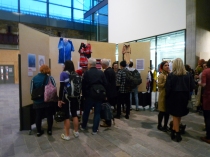
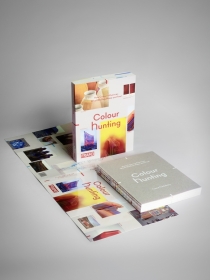
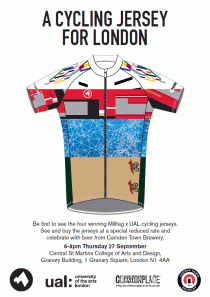
I though I would add some photographs from the private view of the postgraduate courses exhibition at London College of Communication, back in December 2011. There was a great turn out especially for a Monday night in December and it was a chance to celebrate all our hard work and achievements as a course not to mention all the amazing projects that resulted from it. The perfect excuse for a knees up in the Prince of Wales afterwards, a good time was had by all.

The Colour Group are hosting an event at 6pm on Wednesday 7th March at City University, Blue Alchemy, Stories of Indigo. The evening includes networking opportunities plus a showing of a feature length documentary by Mary Lance entitled Blue Alchemy, Stories of Indigo. Jenny Balfour-Paul advised on the film and will also be signing copies of her new book about indigo, Indigo: Egyptian Mummies to Blue Jeans. There will also be a a question and answer session with Mary about the film, drinks and nibbles.

For more details about the event there is a PDF flyer available here.

Tickets are available on the door but registration for the event is advised as places are limited. Registration for the event is available on the Colour Group website

Back in December London College of Communication hosted an exhibition of work by students graduating from its postgraduate programme. With all of the galleries and exhibition spaces across the college building in Elephant and Castle at our disposal, my work was displayed in the Upper Street gallery alongside my coursemates from the MA Graphic Design part time course.

After a disproportionate amount of time spent taping together and rearranging cardboard boxes while fretting about curation the exhibition opened successfully and on time on the 1st of December 2011. Despite being on a Monday night and close to Christmas, there was a good turn out to the private view on Monday 5th. Although the lure of free booze and lack of snow compared to the previous year seemed to be enough to entice people south of the river.

The show was accompanied by a website (my profile can be viewed here) to leave an online legacy for students, long after the exhibition has closed. For those with a print fetish there was also a hefty tomb of a catalogue, with a double page spread showcasing each of the contributing students work. The whole exhibition including signage and invites was tied together with a visual identity comprising of a distinctive modular typeface and a monochrome colour palette of fluorescent red accents on white used throughout.

Ironically there was some debate during the set up of the show as to whether the colour was fluorescent orange or red. It goes to show that there is no escaping arguments about colour. I have posted photos below of the exhibition so you can judge for yourselves. Though it is worth bearing in mind that under the fluorescent glow of the strip lighting at LCC the colour does appear more orange than red, demonstrating just how much of a slippery subject colour perception can be.


Finally, in November after months of initial research and proposals, followed by almost a year of development, research, analysis, design and presentation I handed my MA Graphic Design Major Project, Colourful Language in to the postgraduate tutors at LCC for assessment. The culmination of a total of 17 months of work amounted to a two reports, a series of 13 books, 3 posters and 6 volumes of supporting material. All of the outcomes and background development from the project can be found above in the other sections of this blog or can be viewed as online publications in my profile on issuu.

Although I planned to use this blog to document the progress of the research for my Major Project when I originally wrote the proposal, it proved near impossible to edit and write posts about each piece of new research at the same time as conducting it. As a result posts have been thin on the ground and severely lagging behind events. But despite the MA course having finishing and the project officially having come to an end I have elected to continue this blog and rather than serving as a record of the development of the project I aim to use it to document all things colourful. I will also be posting about segments of my research and links that I have come across as part of the project retrospectively as a way of building a resource of colour and language related material.

Colour and Language Explorations Books

Singer Beyoncé Knowles and husband Jay-Z have named their first child, a baby girl, Blue. Reportedly delivered naturally on Saturday in New York, the child’s full name is Blue Ivy Carter. To the best of my knowledge, Blue has never topped the name charts for either boys or girls (this may now change given the influence of celebrity), it is however, the world’s most popular colour.

Blue is consistently the most frequently chosen favourite colour around the world. Although purple is actually my preferred colour, I had first hand experience of blue’s popularity after nearly a quarter of respondents to my own survey cited it as their favourite colour.


An article and video clip about how red, green and white became the colours we traditionally associate with Christmas. Although the origins of this colour palette are thought to pre-date the Victorian era, going back to Medieval times, that Father Christmas is depicted dressed in red and white is actually a result of early advertising for Coca-cola.


To anyone who visits my blog, I would be really grateful if you could fill in this survey, as part of my Major Project research.

Survey Link:

https://www.surveymonkey.com/s/T2PCTBK

Thank you

Last autumn at the London Art Book Fair at the Whitechapel Gallery I bought a small artist’s book called Stolen White Goods. The publication is anonymous but it was published by the IKON Gallery in Birmingham in 2005 in an edition of 500. It caught my eye because of the title and also because by then I was researching colour for my unit 2 work.

The book documents 36 items, white or whiteish in colour, totaling a value of £46.41 that were stolen from 6 shops in and around Bristol.

From the perspective of my project, it is interesting to see the variety of items that are mundane and commonplace that are synonymous with the colour white. It particularly interested me because it is similar to the Cabinet Magazine column about the colour White which lists a collection of things related to the colour white. While some are white objects, others are things or people associated with white.

The play on ‘white goods’ in the title of the book, is also interesting as that also refers to everyday household goods but of a very different kind. White goods is also one of the English idioms I have been collecting as part of my research.

Although none of the objects photographed are linguistically linked to the name of the colour white, it is interesting to see how they are presented and photographed, very simply, without any context. This is something I must consider with regards to my own project of photographing objects that are the name of a colour.

On Wednesday I had my first tutorial with John after the Easter break. I have produced a fair amount of visual work since our last meeting so there was quite a lot to discuss.The session was a bit disjointed as it was cut short by a lunchtime meeting. However I did managed to catch up with John later in the day to finish the discussion. There is a group seminar next week so I hope to get some more feedback from other people then.

On the whole John seemed pleased with the work I have been doing. The work I have done with Google image search seemed to interest him the most as it asked questions about how google ranks the results of its searches. Although this is not something that I have planned to look at as part of my research it is an interesting point. As I explained that the results for searches change slightly all the time as more content is added to the internet John suggested I could look at repeating the exercise over a period of time, and compare the results. Although I am keen to continue developing visual outcomes for other research I have done I may pursue that suggestion in some way, later in the project.

The only thing that I mentioned that concerned John was the survey I am writing. The survey is unfortunately still not yet live but John raised the problem of what I do if I get a low number of respondents. I have considered this, and although I hope it doesn’t happen there is the possibility of looking at data collected by other people who have done similar research. Of course I would much prefer to have a set of data that I had collected myself, directly tailored to my own research questions but at least I have a Plan B.

Follow

Get every new post delivered to your Inbox.